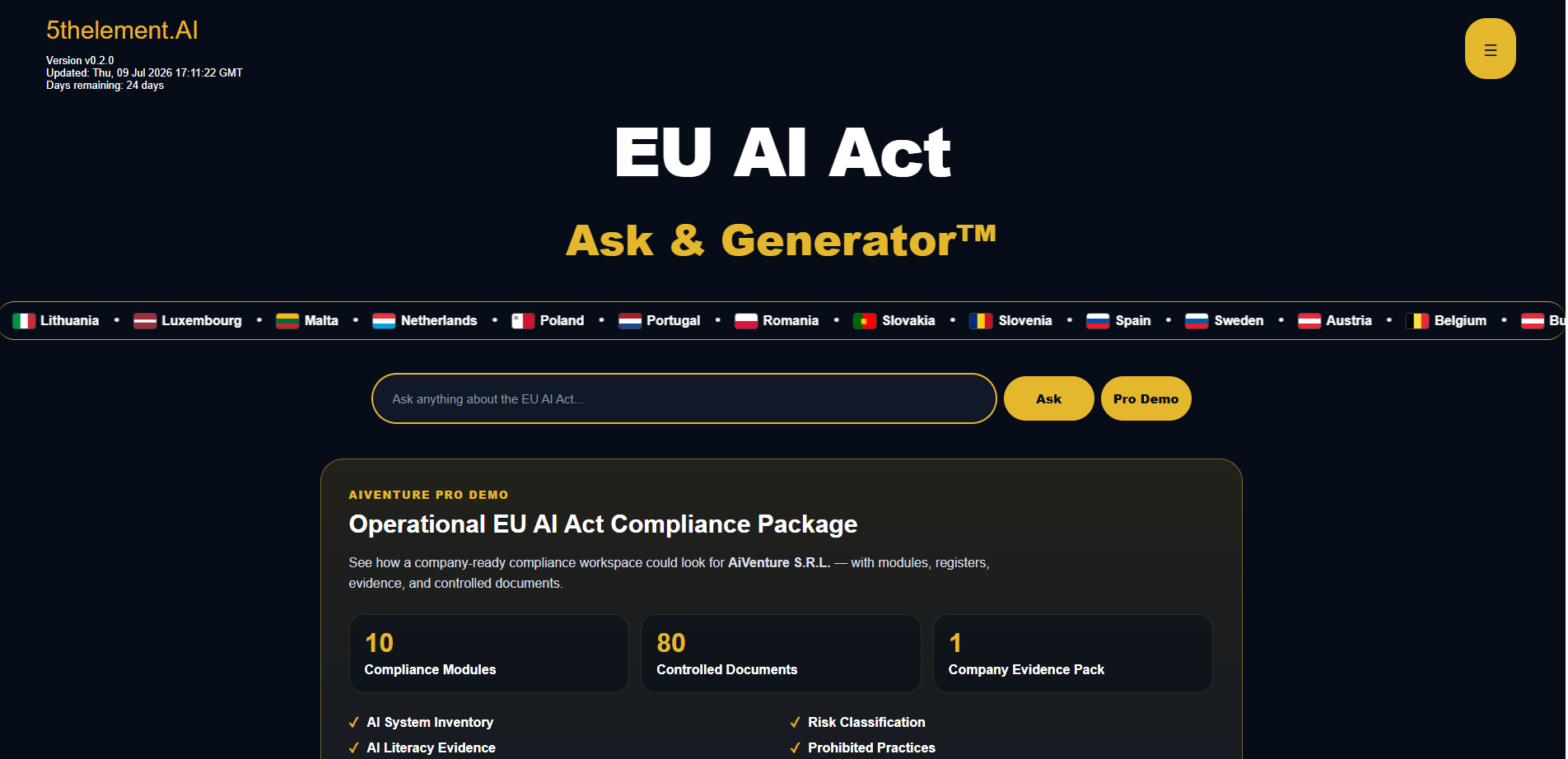
The EU AI Act is coming.
Most companies are not prepared.
It’s the GDPR moment — this time for AI. From 2 August 2026, your website has to show how you use AI. Saying it isn’t enough.
Companies that use AI may face:
- transparency obligations
- disclosure obligations
- documentation requirements
- audit exposure
- procurement rejection risk
- potentially significant penalties
“Wait… we already use AI.”
Exactly.
Most firms already use:
- ChatGPT
- AI marketing
- AI-generated images
- AI automation
- AI customer support
- AI voice tools
- AI assistants
Yet on their public website they show:
ZERO public AI evidence.Four ways AI can be turned against your company.
Your face and brand, recreated by AI.
Convincing fake video, images, and posts of your executives and your company — spreading across feeds before you even know they exist.
Can anyone prove which one is really you?
AI talking to your customers — with no label.
Visitors chat with an AI on your site and never know it. That missing “this is AI” disclosure is exactly what Article 50 is written to catch.
Where do you tell them it’s AI?
And the buyer-side risk: procurement distrust
Enterprise buyers increasingly ask before they’ll sign:
- Where is your AI policy?
- What AI systems do you use?
- Where is your disclosure?
- Can your AI outputs be verified?
No answers = lost trust, before a meeting even happens.
It isn’t only the regulators.
The deeper problem is simpler, and worse: nobody can verify what’s real anymore.
If your company shows no disclosure, no provenance, no evidence, and nothing a machine can check, you can look —
— before a single human conversation even starts.
It’s already reshaping the sectors that live on trust:
All of them are making the same shift — from human trust to machine-verifiable trust.
Could you tell your real voice from an AI clone?
Could a client? Could a bank? Could a journalist? Could ChatGPT?
We explain first. Then you decide.
AiVenture helps firms:
- understand their real exposure
- show their transparency in public
- create public, checkable evidence
- add AI-readable trust signals
- improve machine verification
- cut through AI-era confusion
All without rebuilding your website.
We do not certify compliance. We make your evidence visible, structured, traceable, and inspectable — so people and machines can confirm what’s real about you.
› See the technical part (for your IT person)
ai-proof.json and authority.json — sealed with SHA-256 fingerprints (a unique signature that changes if a file is altered, so tampering shows) and OpenTimestamps anchors (an independent, tamper-proof record of when it was published). That’s what lets AI systems and auditors verify your evidence directly, instead of taking your word for it. Deployed at the edge — your existing site is never rebuilt or slowed.
Think of it like GDPR.
At first, nobody cared. Then:
clients asked.
lawyers asked.
procurement asked.
regulators asked.
The EU AI Act is that same moment — but for AI transparency, AI-generated content, machine trust, and verifiable evidence. The companies that move early won’t be the ones scrambling in August.
Ready for the EU AI law + easy for AI to verify, free.
One setup gets your website ready for the new law — and the AI-readable trust layer that makes you verifiable comes included, at no extra cost.
Compliance leads. The trust layer comes with it.
Your company just entered an era where anyone can fake anything.
The question is no longer “do you use AI?”
It’s “can anyone still tell what’s real about you?” — we help you answer it.